The previous page showed that a time domain signal can be represented as a sum of sinusoidal signals (i.e., the frequency domain), but the method for determining the phase and magnitude of the sinusoids was not discussed. This page will describe how to determine the frequency domain representation of the signal. For now we will consider only periodic signals, though the concept of the frequency domain can be extended to signals that are not periodic (using what is called the Fourier Transform). The next page will give several examples.
Contents
Statement of the Problem
Consider a periodic signal xT(t) with period T (we will write periodic signals with a subscript corresponding to the period). Since the period is T, we take the fundamental frequency to be ω0=2π/T. We can represent any such function (with some very minor restrictions) using Fourier Series.
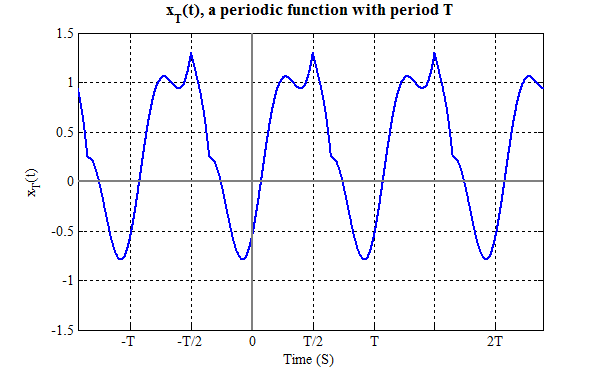
In the early 1800’s Joseph Fourier determined that such a function can be represented as a series of sines and cosines. In other words he showed that a function such as the one above can be represented as a sum of sines and cosines of different frequencies, called a Fourier Series. There are two common forms of the Fourier Series, “Trigonometric” and “Exponential.” These are discussed below, followed by a demonstration that the two forms are equivalent. For easy reference the two forms are stated here, their derivation follows.
The Trigonometric Series
The Fourier Series is more easily understood if we first restrict ourselves to functions that are either even or odd. We will then generalize to any function.
Aside: Even and Odd functions
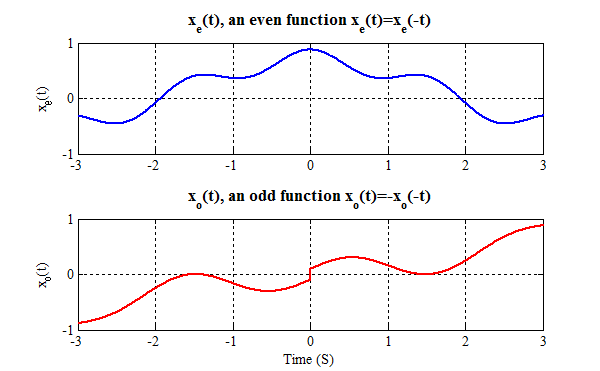
The following derivations require some knowledge of even and odd functions, so a brief review is presented. An even function, xe(t), is symmetric about t=0, so xe(t)=xe(-t). An odd function, xo(t), is antisymmetric about t=0, so xo(t)=-xo(-t) (note: this implies that xo(0)=0). Examples are shown below.
Other important facts about even and odd functions:
- the product of two even functions is an even function. Given two even functions xe1(t) and xe2(t), their product ye(t)=xe1(t) · xe2(t) is even.
- the product of two odd functions is an even function. Given two odd functions xo1(t) and xo2(t), their product ye(t)=xo1(t)·xo2(t) is even.
- the product of an even function and an odd function is an odd function. Given an even function, xe(t) and an odd function xo(t), their product yo(t)=xe(t)·xo(t) is odd.
- the integral of an odd function, xo(t), from t=-a to t=a is equal to zero
- The same is not generally true of even functions. In other words, the integral of an even function, xe(t), from t=-a to t=a is not in general equal to zero (but may be in some cases, for example the cosine function)
- Recall that a cosine is an even function and sine is odd.
Even Functions
An even function, xe(t), can be represented as a sum of cosines of various frequencies via the equation:
Since cos(nω0t)=1 when n=0 the series is more commonly written as
This is called the “synthesis” equation because it shows how we create, or synthesize, the function xe(t) by adding up cosines.
An example will demonstrate exactly how the summation describing the synthesis process works. Consider the following function, xT and its corresponding values for an. This function has T=1 so ω0=2·π/T=2·π. Note: we have not determined how the an are calculated; that derivation follows, that calculation comes later.
- The top graph corresponds to a0, a constant term. We will show later that this is the average value of the original function (a pulse of width 0.4 and period T=1, so average=0.4). This is often called the average, the DC, or the zero frequency () component of the Fourier series.
(note: {a0cos(0·ω0·t) = a0) - The second graph is of a1cos(ω0t). Note that it has exactly one oscillation of the cosine in the period, T=1. We call this the 1st, or fundamental harmonic. The amplitude of this harmonic is given by a1=0.6055.
- The 2nd harmonic (n=2) has exactly two oscillations in one period, T=1, of the original function, and an amplitude of a2=0.1871.
- The 3rd harmonic (n=3) has exactly three oscillations in one period, T=1, of the original function, and an amplitude of a3=-0.1247.
- …and so on, for increasing values of n.
The right column shows the sum $$ a_{0} + \sum_{n = 1}^{N} a_{n} cos \left(\right. n \left(\omega\right)_{0} t \left.\right)
- The topmost graph shows the constant (or average) value determined by *a<sub>0</sub>\=0.4*. This value is shown in blue, the original function is shown in red. - The second graph shows (in blue) the summation with N=1. It is the sum of the constant value plus the 1st harmonic *(a<sub>0</sub>+a<sub>1</sub>cos(ω<sub>0</sub>t))*. In other words the second graph on the right shows the sum of the first two graphs on the left. With only one harmonic the Fourier sum (blue) already has the character of the original (red) - they are both high in the middle. - The third graph on the right (which is the sum of the first three graphs on the left) is not much different than the second because the added term. *a<sub>2</sub>cos(2ω<sub>0</sub>t)* is not very large. However, careful inspection yields that the third graph (blue) is a better fit to the original function (red) than the previous one. - The fourth graph on the right (the sum of the first four graphs on the left, *(a<sub>0</sub> + a<sub>1</sub>cos(ω<sub>0</sub> t) + a<sub>2</sub>cos(2ω <sub>0</sub>t) + a<sub>3</sub>cos(ω<sub>0</sub>t))* and the Fourier sum approximation is even better than before. - ...and so on, for increasing values of *n*. #### How do we find *a<sub>n</sub>*? The example above shows how the harmonics add to approximate the original question, but begs the question of how to find the magnitudes of the *a<sub>n</sub>*. Start with the synthesis equation of the Fourier Series for an even function x<sub>e</sub>(t) (note, in this equation, that n≥0).x_{e} \left(\right. t \left.\right) = \sum_{n = 0}^{\infty} a_{n} cos \left(\right. n \left(\omega\right)_{0} t \left.\right)
Now, without justification we multiply both sides by $cos \left(\right. m \left(\omega\right)_{0} t \left.\right)$x_{e} \left(\right. t \left.\right) cos \left(\right. m \left(\omega\right){0} t \left.\right) = \sum{n = 0}^{\infty} a_{n} cos \left(\right. n \left(\omega\right){0} t \left.\right) cos \left(\right. m \left(\omega\right){0} t \left.\right)
\underset{T}{\int} x_{e} \left(\right. t \left.\right) cos \left(\right. m \left(\omega\right){0} t \left.\right) d t = \underset{T}{\int} \sum{n = 0}^{\infty} a_{n} cos \left(\right. n \left(\omega\right){0} t \left.\right) cos \left(\right. m \left(\omega\right){0} t \left.\right) d t
\underset{T}{\int} x_{e} \left(\right. t \left.\right) cos \left(\right. m \left(\omega\right){0} t \left.\right) d t & = \sum{n = 0}^{\infty} a_{n} \underset{T}{\int} cos \left(\right. n \left(\omega\right){0} t \left.\right) cos \left(\right. m \left(\omega\right){0} t \left.\right) d t \ & = \sum_{n = 0}^{\infty} a_{n} \underset{T}{\int} \frac{1}{2} \left(\right. cos \left(\right. \left(\right. m + n \left.\right) \left(\omega\right){0} t \left.\right) + cos \left(\right. \left(\right. m - n \left.\right) \left(\omega\right){0} t \left.\right) \left.\right) d t \ & = \frac{1}{2} \sum_{n = 0}^{\infty} a_{n} \underset{T}{\int} \left(\right. cos \left(\right. \left(\right. n + m \left.\right) \left(\omega\right){0} t \left.\right) + cos \left(\right. \left(\right. m - n \left.\right) \left(\omega\right){0} t \left.\right) \left.\right) d t
\underset{T}{\int} x_{e} \left(\right. t \left.\right) cos \left(\right. m \left(\omega\right){0} t \left.\right) d t & = \frac{1}{2} \sum{n = 0}^{\infty} a_{n} \underset{T}{\int} \left(\right. cos \left(\right. \left(\right. n + m \left.\right) \left(\omega\right){0} t \left.\right) + cos \left(\right. \left(\right. m - n \left.\right) \left(\omega\right){0} t \left.\right) \left.\right) d t \ & = \frac{1}{2} \sum_{n = 0}^{\infty} a_{n} \left(\right. \underset{T}{\int} cos \left(\right. \left(\right. n + m \left.\right) \left(\omega\right){0} t \left.\right) d t + \underset{T}{\int} cos \left(\right. \left(\right. m - n \left.\right) \left(\omega\right){0} t \left.\right) d t \left.\right) \ & = \frac{1}{2} \sum_{n = 0}^{\infty} a_{n} \underset{T}{\int} cos \left(\right. \left(\right. m - n \left.\right) \left(\omega\right)_{0} t \left.\right) d t
\underset{T}{\int} cos \left(\right. \left(\right. m - n \left.\right) \left(\omega\right){0} t \left.\right) d t = \left{\right. \underset{T}{\int} cos \left(\right. \left(\right. m - n \left.\right) \left(\omega\right){0} t \left.\right) d t = 0 , m \neq n \ \underset{T}{\int} 1 \cdot d t = T , m = n
\underset{T}{\int} x_{e} \left(\right. t \left.\right) cos \left(\right. m \left(\omega\right){0} t \left.\right) d t = \frac{1}{2} \sum{n = 0}^{\infty} a_{n} \underset{T}{\int} cos \left(\right. \left(\right. m - n \left.\right) \left(\omega\right)_{0} t \left.\right) d t
\underset{T}{\int} x_{e} \left(\right. t \left.\right) cos \left(\right. m \left(\omega\right){0} t \left.\right) d t = \frac{1}{2} a{m} T \ a_{m} = \frac{2}{T} \underset{T}{\int} x_{e} \left(\right. t \left.\right) cos \left(\right. m \left(\omega\right){0} t \left.\right) d t \ a{n} = \frac{2}{T} \underset{T}{\int} x_{e} \left(\right. t \left.\right) cos \left(\right. n \left(\omega\right)_{0} t \left.\right) d t
We switched *m* to *n* in the last line since *m* is just a dummy variable. We now have an expression for *a<sub>n</sub>*, which was our goal. ##### Aside: Further explanation of previous step In the text above, the equating of the two termsa_{m} T = \sum_{n = 0}^{\infty} a_{n} \underset{T}{\int} cos \left(\right. \left(\right. m - n \left.\right) \left(\omega\right)_{0} t \left.\right) d t
a_{2} T & = \sum_{n = 0}^{\infty} a_{n} \underset{T}{\int} cos \left(\right. \left(\right. 2 - n \left.\right) \left(\omega\right){0} t \left.\right) d t \ & = a{0} \underset{T}{\int} cos \left(\right. \left(\right. 2 - 0 \left.\right) \left(\omega\right){0} t \left.\right) d t + a{1} \underset{T}{\int} cos \left(\right. \left(\right. 2 - 1 \left.\right) \left(\omega\right){0} t \left.\right) d t + a{2} \underset{T}{\int} cos \left(\right. \left(\right. 2 - 2 \left.\right) \left(\omega\right){0} t \left.\right) d t + a{3} \underset{T}{\int} cos \left(\right. \left(\right. 2 - 3 \left.\right) \left(\omega\right){0} t \left.\right) d t + \hdots \ & = a{0} \underset{T}{\int} cos \left(\right. 2 \cdot \left(\omega\right){0} t \left.\right) d t + a{1} \underset{T}{\int} cos \left(\right. 1 \cdot \left(\omega\right){0} t \left.\right) d t + a{2} \underset{T}{\int} cos \left(\right. 0 \cdot \left(\omega\right){0} t \left.\right) d t + a{3} \underset{T}{\int} cos \left(\right. - 1 \cdot \left(\omega\right){0} t \left.\right) d t + \hdots \ & = a{0} \underset{T}{\int} cos \left(\right. 2 \cdot \left(\omega\right){0} t \left.\right) d t + a{1} \underset{T}{\int} cos \left(\right. 1 \cdot \left(\omega\right){0} t \left.\right) d t + a{2} \underset{T}{\int} d t + a_{3} \underset{T}{\int} cos \left(\right. 1 \cdot \left(\omega\right)_{0} t \left.\right) d t + \hdots
In the last line we used the fact that *cos(0)=1* and *cos(-x)=cos(x)*. All of the integrals but the third one will go to zero because the integration is over an integer number of oscillations (as will all of the omitted terms). The third integral becomes *a<sub>2</sub>T*, as was expected. ##### Aside: Orthogonality of functions (you may skip this if you would like to - it is not necessary to proceed). In the discussion above we use the fact that\underset{T}{\int} cos \left(\right. n \left(\omega\right){0} t \left.\right) cos \left(\right. m \left(\omega\right){0} t \left.\right) d t = \left{\right. \frac{T}{2} , m = n \ 0 , m \neq n
\mathbf{x} & = \left[\right. \begin{matrix}x_{1} & x_{2} & x_{3} & x_{4}\end{matrix} \left]\right. \mathbf{y} = \left[\right. \left(\begin{matrix}y_{1} & y_{2} & y_{3} & y\end{matrix}\right){4} \left]\right. \ \mathbf{x} \cdot \mathbf{y} & = x{1} y_{1} + x_{2} y_{2} + x_{3} y_{3} + x_{4} y_{4} \ & = \sum_{i = 1}^{N} x_{i} y_{i}
\underset{T}{\int} x_{e} \left(\right. t \left.\right) cos \left(\right. m \left(\omega\right){0} t \left.\right) d t & = \sum{n = 0}^{\infty} a_{n} \underset{T}{\int} cos \left(\right. n \left(\omega\right){0} t \left.\right) cos \left(\right. m \left(\omega\right){0} t \left.\right) d t \ \underset{T}{\int} x_{e} \left(\right. t \left.\right) cos \left(\right. 0 \cdot \left(\omega\right){0} t \left.\right) d t & = \sum{n = 0}^{\infty} a_{n} \underset{T}{\int} cos \left(\right. n \left(\omega\right){0} t \left.\right) cos \left(\right. 0 \cdot \left(\omega\right){0} t \left.\right) d t \text{but}&\text{nbsp}; cos \left(\right. 0 \cdot \left(\omega\right){0} t \left.\right) & = 1 \ \underset{T}{\int} x{e} \left(\right. t \left.\right) d t & = \sum_{n = 0}^{\infty} a_{n} \underset{T}{\int} cos \left(\right. n \left(\omega\right){0} t \left.\right) d t \ \underset{T}{\int} x{e} \left(\right. t \left.\right) d t & = T a_{0}
a_{0} = \frac{1}{T} \underset{T}{\int} x_{e} \left(\right. t \left.\right) d t = \left(\text{average of x}\right)_{e} \left(\right. t \left.\right)
### Odd Functions An odd function can be represented by a Fourier Sine series (to represent even functions we used cosines (an even function), so it is not surprising that we use sinusoids.x_{o} \left(\right. t \left.\right) = \sum_{n = 1}^{\infty} b_{n} sin \left(\right. n \left(\omega\right)_{0} t \left.\right)
b_{n} = \frac{2}{T} \underset{T}{\int} x_{o} \left(\right. t \left.\right) sin \left(\right. n \left(\omega\right)_{0} t \left.\right) d t
The derivation closely follows that for the *a<sub>n</sub>* coefficients. ### Arbitrary Functions (not necessarily even or odd) Any function can be composed of an even and an odd part. Given a function *x(t)*, we can create even and odd functionsx_{o} \left(\right. t \left.\right) = \frac{1}{2} \left(\right. x \left(\right. t \left.\right) - x \left(\right. - t \left.\right) \left.\right) \ x_{e} \left(\right. t \left.\right) = \frac{1}{2} \left(\right. x \left(\right. t \left.\right) + x \left(\right. - t \left.\right) \left.\right)
Clearly, *x<sub>o</sub>(t)=-x<sub>o</sub>(-t)* and *x<sub>e</sub>(t)=x<sub>e</sub>(-t)*, and when added together they create the original function. *x(t)=x<sub>o</sub>(t)+x<sub>e</sub>(t)*. We can use a Fourier cosine series to find the *a<sub>n</sub>* associated with *x<sub>e</sub>(t)* and a Fourier sine series to find the *b<sub>n</sub>* associated with *x<sub>o</sub>(t)*. ##### Key Concept: Trigonometric Analysis and Synthesis Equations Given a periodic function *x<sub>T</sub>*, we can represent it by the Fourier series synthesis equationsx_{T} \left(\right. t \left.\right) = a_{0} + \sum_{n = 1}^{\infty} \left(\right. a_{n} cos \left(\right. n \left(\omega\right){0} t \left.\right) + b{n} sin \left(\right. n \left(\omega\right)_{0} t \left.\right) \left.\right)
a_{0} & = \frac{1}{T} \underset{T}{\int} x_{T} \left(\right. t \left.\right) d t = a v e r a g e \ a_{n} & = \frac{2}{T} \underset{T}{\int} x_{T} \left(\right. t \left.\right) cos \left(\right. n \left(\omega\right){0} t \left.\right) d t , n \neq 0 \ b{n} & = \frac{2}{T} \underset{T}{\int} x_{T} \left(\right. t \left.\right) sin \left(\right. n \left(\omega\right)_{0} t \left.\right) d t
## The Exponential Series A more compact representation of the Fourier Series uses complex exponentials. In this case we end up with the following synthesis and analysis equations:x_{T} \left(\right. t \left.\right) = \sum_{n = - \infty}^{+ \infty} c_{n} e^{j n \left(\omega\right){0} t} S y n t h e s i s \ c{n} = \frac{1}{T} \underset{T}{\int} x \left(\right. t \left.\right) e^{- j n \left(\omega\right)_{0} t} d t A n a l y s i s
The derivation is similar to that for the Fourier cosine series given above. Note that this form is quite a bit more compact than that of the trigonometric series; that is one of its primary appeals. Other advantages include: a single analysis equation (versus three equations for the trigonometric form), notation is similar to that of the Fourier Transform (to be [discussed later](https://lpsa.swarthmore.edu/Fourier/Series/FTFS.html)), it is often easier to mathematically manipulate exponentials rather sines and cosines. A principle advantage of the trigonometric form is that it is easier to visualize sines and cosines (in part because the *c<sub>n</sub>* are complex number,, and the series can be easily used if the original *x<sub>T</sub>* is either purely even or odd. ##### Key Concept: Exponential Analysis and Synthesis Equationsx_{T} \left(\right. t \left.\right) = \sum_{n = - \infty}^{+ \infty} c_{n} e^{j n \left(\omega\right){0} t} S y n t h e s i s \ c{n} = \frac{1}{T} \underset{T}{\int} x \left(\right. t \left.\right) e^{- j n \left(\omega\right)_{0} t} d t A n a l y s i s
## The Equivalence of the Trigonometric and Exponential Series If the trigonometricx_{T} \left(\right. t \left.\right) = a_{0} + \sum_{n = 1}^{\infty} \left(\right. a_{n} cos \left(\right. n \left(\omega\right){0} t \left.\right) + b{n} sin \left(\right. n \left(\omega\right)_{0} t \left.\right) \left.\right)
x_{T} \left(\right. t \left.\right) = \sum_{n = - \infty}^{+ \infty} c_{n} e^{j n \left(\omega\right)_{0} t}
a_{0} + \sum_{n = 1}^{\infty} \left(\right. a_{n} cos \left(\right. n \left(\omega\right){0} t \left.\right) + b{n} sin \left(\right. n \left(\omega\right){0} t \left.\right) \left.\right) = \sum{n = - \infty}^{+ \infty} c_{n} e^{j n \left(\omega\right)_{0} t}
a_{0} = c_{0}
a_{1} cos \left(\right. \left(\omega\right){0} t \left.\right) + b{1} sin \left(\right. \left(\omega\right){0} t \left.\right) = c{- 1} e^{- j \left(\omega\right){0} t} + c{1} e^{+ j \left(\omega\right)_{0} t}
a_{2} cos \left(\right. 2 \left(\omega\right){0} t \left.\right) + b{2} sin \left(\right. 2 \left(\omega\right){0} t \left.\right) = c{- 2} e^{- j 2 \left(\omega\right){0} t} + c{2} e^{+ j 2 \left(\omega\right)_{0} t}
a_{n} cos \left(\right. n \left(\omega\right){0} t \left.\right) + b{n} sin \left(\right. n \left(\omega\right){0} t \left.\right) = c{- n} e^{- j n \left(\omega\right){0} t} + c{n} e^{+ j n \left(\omega\right)_{0} t}
a_{n} cos \left(\right. n \left(\omega\right){0} t \left.\right) + b{n} sin \left(\right. n \left(\omega\right){0} t \left.\right) & = c{- n} e^{- j n \left(\omega\right){0} t} + c{n} e^{+ j n \left(\omega\right){0} t} \ & = \left(\right. c{n , r} - j c_{n , i} \left.\right) \left(\right. cos \left(\right. n \left(\omega\right){0} t \left.\right) - j sin \left(\right. n \left(\omega\right){0} t \left.\right) \left.\right) + \left(\right. c_{n , r} + j c_{n , i} \left.\right) \left(\right. cos \left(\right. n \left(\omega\right){0} t \left.\right) + j sin \left(\right. n \left(\omega\right){0} t \left.\right) \left.\right) \ & = 2 c_{n , r} cos \left(\right. n \left(\omega\right){0} t \left.\right) - 2 c{n , i} sin \left(\right. n \left(\omega\right){0} t \left.\right) + j \left(\right. cos \left(\right. n \left(\omega\right){0} t \left.\right) \left(\right. c_{n , r} - c_{n , r} \left.\right) + sin \left(\right. n \left(\omega\right){0} t \left.\right) \left(\right. c{n , i} - c_{n , i} \left.\right) \left.\right) \ & = 2 c_{n , r} cos \left(\right. n \left(\omega\right){0} t \left.\right) - 2 c{n , i} sin \left(\right. n \left(\omega\right)_{0} t \left.\right)
a_{n} = 2 c_{n , r} \ b_{n} = - 2 c_{n , i}
c_{n} = \frac{a_{n}}{2} - j \frac{b_{n}}{2} , &\text{nbsp}; n \neq 0 , w i t h &\text{nbsp}; c_{- n} = c_{n}^{*}
##### Key Concept: Equivalence of Trigonometric and Exponential Forms The trigonometricx_{T} \left(\right. t \left.\right) = a_{0} + \sum_{n = 1}^{\infty} \left(\right. a_{n} cos \left(\right. n \left(\omega\right){0} t \left.\right) + b{n} sin \left(\right. n \left(\omega\right)_{0} t \left.\right) \left.\right)
x_{T} \left(\right. t \left.\right) = \sum_{n = - \infty}^{+ \infty} c_{n} e^{j n \left(\omega\right)_{0} t}
a_{0} = c_{0}
c_{n} & = c_{n , r} + j c_{n , i} \ a_{n} & = 2 c_{n , r} , n \neq 0 \ b_{n} & = - 2 c_{n , i}
c_{n} = \frac{a_{n}}{2} - j \frac{b_{n}}{2} , w i t h &\text{nbsp}; c_{- n} = c_{n}^{*}
## Limitations As stated earlier, there are certain limitations inherent in the use of the Fourier Series. These are almost never of interest in engineering applications. In particular, the Fourier series converges - if $\underset{T}{\int} x_{T} \left(\right. t \left.\right) d t < \infty$, i.e., as long as the function is not infinite over a finite interval, - if *x<sub>T</sub>* has a finite number of discontinuities in one period, - if *x<sub>T</sub>* has a finite number of maxima and minima in one period, - except at discontinuities, where it converges to the midpoint of the discontinuity. At a discontinuity there is an overshoot (Gibb's phenomenon - about 9% for a square wave). However this discontinuity becomes vanishingly narrow (and it's area, and energy, are zero), and therefore irrelevant as we sum up more terms of the series. ## An Easier Way After you have studied [Fourier Transforms](https://lpsa.swarthmore.edu/Fourier/Xforms/FXformIntro.html), you will learn that there is [an easier way to find Fourier Series coefficients](https://lpsa.swarthmore.edu/Fourier/Xforms/FXFS.html) for a wide variety of functions that does not require any integration. --- [References](https://lpsa.swarthmore.edu/References.html)